Manufacturers

Manufacturers and processors of hemp into finished or semi-finished products across multiple industries.

Building, Manufacturers, News, Newsletter, Processors

Understanding Health Hazards in Hemp Processing

By Dr Maggie Davidson MAIOH, Senior Lecturer, Environmental Health & Occupation Hygiene, School of Science, Western Sydney University. Farming is one of the most hazardous jobs. Farmers often live where they work, so there’s little time for rest — especially for their lungs. While accidents are common, long-term health risks from dust, noise, and chemicals often get overlooked. In hemp processing, dust and noise are big issues. But we still know very little about how much dust and noise are actually produced, or which tasks cause the most exposure. This information is important because it helps us find better ways to protect processors, farmers and workers and prevent serious health problems. Organic dust from hemp can cause serious lung issues. Inhaling a lot of dust can lead to: Airway irritation and allergies Byssinosis (“Monday morning fever”) Farmers’ lung (hypersensitivity pneumonitis) Chronic bronchitis What We Did From January to March 2025, we visited hemp processors to observe the work environment and measure dust and noise levels. We took dust samples from the air around workers during different jobs like loading machines, bagging products, cleaning, and maintenance. Dust particles we measured were tiny — less than one-tenth the width of a human hair — meaning they can easily reach deep into the lungs. Key Findings Dust levels peaked at 1.0 to 3.0 mg/m³ during dry sweeping and using air blowers. Loading hammer mills and decorticators produced 0.5 to 1.0 mg/m³ of dust. Safe Work Australia sets the exposure limit at 1.0 mg/m³ over an 8-hour shift. So, sweeping and blowing created dangerous levels. Some dust contained respirable silica, which can cause severe lung disease. Levels reached up to 0.045 mg/m³, close to the legal limit of 0.05 mg/m³. Biggest Risk Areas Loading hammer mills and decorticators Cleaning dust filtration systems Using blowers and dry sweeping What Needs to Change To protect workers: Stop using blowers and dry sweeping immediately — they create the most dust. Use wet cleaning methods and HEPA H-Class vacuums (AS/NZS 60335.2.69 standard). Apply the Hierarchy of Controls: Eliminate/Substitute: Only buy clean, quality hemp with no mould, dust, or contamination. Engineering/Isolation: Install barriers and dust extraction systems to trap dust before it spreads. Administrative Controls: Schedule regular cleaning and machine maintenance. Ban sweeping and air blowers. Personal Protective Equipment (PPE): Supply and train workers to properly use Class 2 or 3 respirators, fitted and tested for the right protection. Where to Find Help Safe Work Australia has excellent free resources: Managing Work Health and Safety Risks Managing Hazardous Chemicals Preventing Hearing Loss at Work What’s Next We are working with hemp processors to develop dust and noise management plans. We’ll revisit them in 2025–2026 to see how improvements are going and share updates at industry events later in 2025. Thank You A huge thanks to the farmers, businesses, and partners who welcomed us. Special thanks to the AIOH Foundation and Western Sydney University for funding this important work.    

News, Building, Education, Growers, Manufacturers, Processors

An Industrial Hemp Hub for NSW Central West

YOUR INVITED TO A Meeting to discuss the formation of an Industrial Hemp Hub for the NSW Central West  When: Friday 22 November (11:00am and finish around 3:00pm) Where: WSU Transition Hub (corner of Mort & Bridge Streets, Lithgow) What: a two-part meeting to discuss:  what an Industrial Hemp Hub is and would do in the region (11:00-12:30pm)  an overview and feedback on known opportunities and interests in the Lithgow and Central Western Region (1:30-3:00pm).As part of the workshop, participants will visit the Lithgow Women’s Shed, a beautiful hempcrete build in progress. Background Who suggested this meeting? John Muir is working with Ken Dodds as part of a new CRC-P (Cooperative Research Centre) funded by the Federal Government and REVOX (a private company with links to Melbourne University). They are looking at recycling materials to mix with hemp and identify ‘hubs’ within regional rural communities with enough like-minded individuals, who would be willing to share resources and experience to create working supply chains that grow and supply a range of industrial hemp products. Why Lithgow? Lithgow is now home to one of the larger public buildings constructed with hempcrete. It’s s a region where local government is highly focused on regional development (including agriculture) as the area transitions away from coal. This makes it potentially eligible for transition funding once the State Government releases its program of Transition Authorities for regions like ours. Lithgow Transition Hub (Western Sydney University) A series of workshops will be hosted in Lithgow in February as part of an academic research program aimed at generated a ‘social-license’ for growing and manufacturing products from industrial hemp. That program will be led by Prof Neil Perry (WSU) with Prof Louise Crabtree (WSU), Dr Stephen Heally (WSU) and Dr Michelle Zeibots (UTS). This November meeting is being approached as an opportunity to scope the content, structure and discussion points for the more detailed workshops in February. If you would like to attend, please contact: Dr Michelle Zeibots MPIA CILT Senior Lecturer (Transport) School of Civil & Environmental Engineering Faculty of Engineering & Information Technology University of Technology Sydney M. 0408 437 687 PO Box 123 Broadway NSW 2007 Australia

Three men standing
Education, Manufacturers, News, Newsletter, Processors

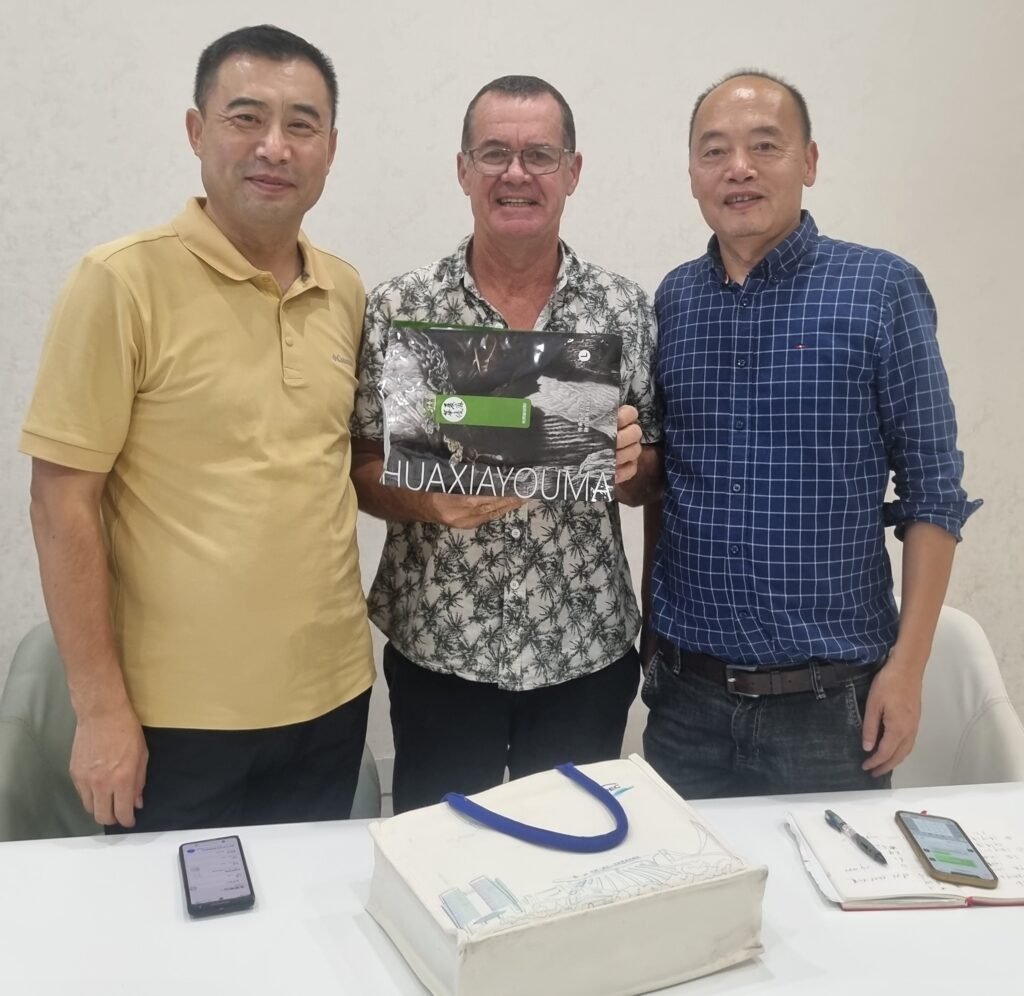
My Amazing Visit to China – By Colin Steddy

My Amazing Visit to China 4 -16 October 2024 By Colin Steddy – Hemp Inside Access to seed I flew to Xiamen and was driven to Zhangpu, to catchup with Mr Xu and his father Rong Long from ZHANGPU ZHONGLONG KENAF SEEDS CO, LTD. I first imported seed from Xu in 2017 after my visit in 2016 and have kept close contact since. We have formed a strong relationship. Working together with ideas on how to do more than just seed. China can now get permits to grow in most parts of China. The THC must be below 0.35 unless you have a breeding licence. Mr Xu has a breeding program with a government centre in China, paid for by Xu, looking at hybrid hemp seed production. For me, it was an interesting site visit because: we are talking new varieties of hemp the breeding program is looking at 4 tonnes per ha, so hemp can compete with soy. Currently there is a world shortage of hemp seed for food and planting seed. I am hearing reports of low yields and low germination across the world. ZHANGPU ZHONGLONG KENAF SEEDS CO, LTD has potential to produce eight hundred tonnes of planting seed for export around the world. Hunter Valley Hemp Seed & Grain, a new enterprise with Bob and Susan Doyle and myself. We will be growing the Chinese varieties in early 2025 for planting in the 2025 September season. We will also export. Please contact me for information. Details below. Research needed New research needs to be done on the flowering and pollen drop with dioicous varieties. With the findings that seed from around the world is having issues with low seed germination and bad vigour. We thought this was to do with heat and temperature; there is more to learn about the flowering times especially in diecious varieties. Mr Xu and I have been working on a seed testing protocol. When male pollen falls, are the females ready and what are the weather conditions? Is it cold and wet are the day length short? This looks like the results at Hamilton in Victoria for the long season varieties. Because of cold short days there was little seed produced exactly as I have been suggesting. Long season seed crops should be grown in the north then moved south for fibre and biomass production. Could this also be a result of germination rates falling quickly and low plant vigour? We are looking for the collection of flowering and weather conditions in relation to germination rate drop and low seed vigour. I would like our researchers to look at this. Exploring seed testing protocols We are looking at building new seed testing protocols on how to monitor what might happen with seed longevity. The hemp industry in Australia needs to keep all data from planting and fertiliser inputs and timing. What triggers THC spikes? Why do seeds loose germination? Fibre quality, planting density (plants per m2) and fertilise can have an enormous impact. Let alone how the machinery and retting occur. Know the spec from the end user? In the north of Australia long season varieties continually get higher grain yields. South European, and some Australian varieties do better than in the hot north. How you move the varieties in latitude will give you a different outcome, seed size, yield, or biomass. This also happens in China just south to north. See AgriFutures hemp trial results from all sites in Australia. The one thing that has not been calculated in the result is grain yield/price and biomass price. As a grower we need to know the total income from a crop. You can work this out yourself. Find the yields of biomass and seed and give them a value on current market. I work on $2.65 for grain and $3.50 for biomass as the stalk is less value than just a biomass crop. Currently in China there is a large demand for hemp fibre and China is sourcing fibre from every corner of the world. Is your fibre going into textiles, insulation, weed matting or paper? Each end product requires different specs and price. How much hurd can be in the fibre? Or is it a whole stalk product? My visit to a textile mill I visited a textile mill in Shanghai (CPL) that want to purchase textile fibre from Australia; the mill makes clothing, with hemp blended with other fibres. Lisa was my interpreter and looked after me. Their demand is growing, and they could be looking for up to 10,000 tonnes! Once again, I was treated like a king and taken to dinner and sightseeing to Xitang, an old Chinese town. Usually it is very crowed, but it was raining and was thankfully incredibly quiet. The market was a maze of thin walkways with shops selling food and a vast array of items big and small. It was very beautiful. This mill has a contact living in South Australia. His name is Yao Yang, and he kindly organised my visit. I wanted to see the fibre quality they need so I can help Australian growers and processors meet the specifications. Today there is a massive shortage of textile hemp fibre – how long it will last, we do not know. I introduced them to Mr Xu, my friend in Zhangpu. Unlike Australia, the industry in China is large and they were not familiar with each other. Along with Lisa, my interpreter, Mr Chunlei Hou and Professor Fan, a polymer academic took me to lunch. They were very warm and friendly. Before we drove to the mill, we discussed growing the right fibre, retting and what spec they need. They have some samples from Australia that need to have less hurd – below 10% is ok. The only mill I know that is close to their spec is Gary Rogers in WA and Bob and Susan Doyles’ that needs a few modifications to clean the fibre and the dust extraction.

Building, Manufacturers, News, Newsletter, Processors

Ashford Hemp Industries processing for the building industry

  Leon and Connie Minos have been riding a wave of increased enthusiasm and demand for their Ashford Hemp Industries’ products over the past decade.  Since developing their own hemp processing system in 2018 to address a bottleneck in the hemp industry, their business digressed from growing hemp in northwest NSW to designing and building the containerised Ashford Hemp Processor, or AHP. The first AHP was sold in Tasmania to the dynamic Andi Lucas of X-Hemp, followed by another sale in New Zealand and South Australia.  In 2024 Ashford Hemp Industries returned focus to increasing their local hemp supply by accessing quality hemp bales in their regional area. The consistent supply of quality hurd for the building sector had been impeded by a lack of regionally available suitable hemp bales which saw the processing facility at Ashford shut down for weeks at a time.  Connie and Leon are confident that this supply issue will be addressed in the coming season. Ashford Hemp Industries has been able to secure over 200 tonnes of excellent quality hemp bales from the Tamworth area, and expects this supply to more than double next year. In addition to providing employment for the small rural town of Ashford, the hemp processing facility expects to generate enough hemp hurd to allow two new house builds each week.  The increase in Australian grown and processed hurd will help supply a market which is longing for quality Australian hemp in their building products. With the Ashford processing facility running at full capacity, the Minos’ look forward to building their fourth Ashford Hemp Processor later this year.  Further information on Ashford Hemp Industries can be gathered from their Facebook page, website or email connie@ashfordhempindustries.com.

Scroll to Top