What to expect from hemp fibre webinar 2 on Tuesday 17 November
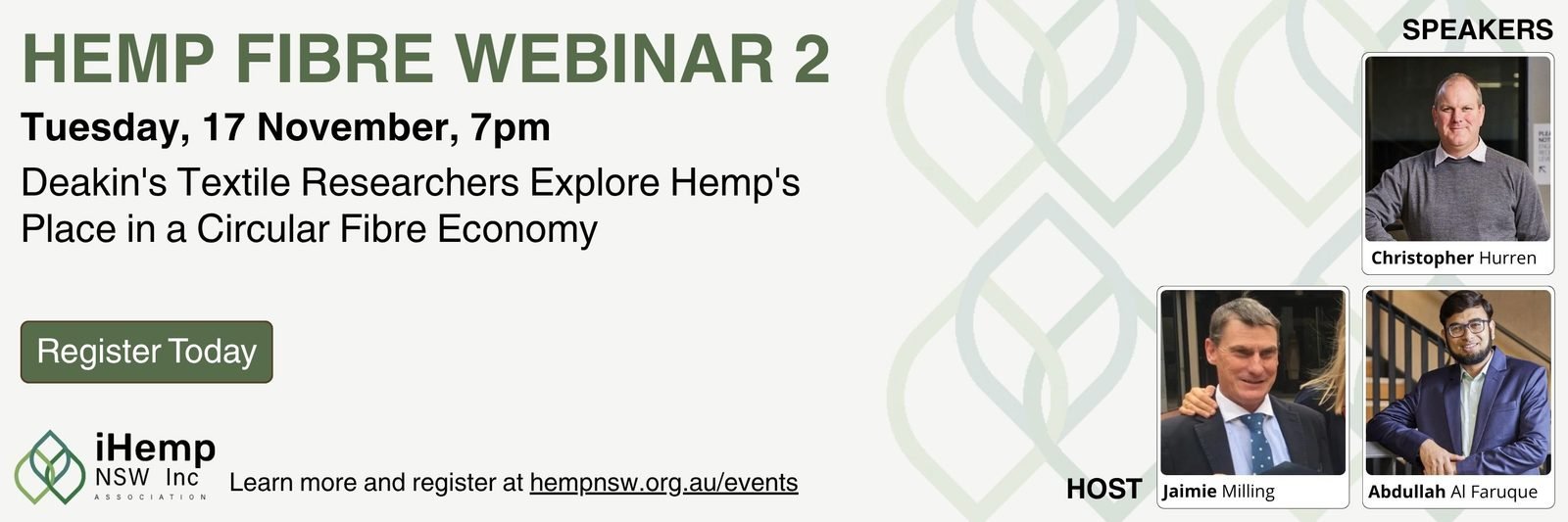
Hemp has long been talked about as a fibre with huge potential, but turning that potential into fabric takes the right science, the right processing and the right partners. That’s the thinking behind our next session. On Tuesday 17 November, iHemp NSW hosts hemp fibre webinar 2, with two researchers from Deakin University’s Future Fibres Facility.
Meet the speakers
Dr Md Abdullah Al Faruque is an Associate Research Fellow at the Deakin Institute for Frontier Materials. A translational textile researcher, he specialises in sustainable textile manufacturing, fibre processing, textile colouration and circular textile innovation. He works within the ARC Research Hub for Future Fibres and has collaborated with industry partners including Michell Wool, Eqwools, FibreTrace, CHT and Archroma. His work has already reached industrial scale, including cotton-wool processing and dyeing technologies used in commercial manufacturing. He is keen to explore hemp in blended textiles with cotton and wool, aiming to improve functionality, resource efficiency and circularity.
Associate Professor Christopher Hurren brings deep expertise across natural and synthetic fibres, circular textile systems and textile composting. He is Research Director for the Deakin/RMIT Future Textiles CRC bid and manages the Future Fibres Facility, which supports Deakin’s “Lab to Label” approach. Before academia, he spent eight years in industry as a textile colourist, spinner and fabric finisher, so he knows the manufacturing chain from the inside. He also led the team that developed MotoCAP, the Motorcycle Clothing Assessment Program introduced in Australia and New Zealand in 2018. His group’s research covers composting of textiles at end of use, mechanical and chemical recycling, melt extrusion of new fibres and short staple spinning.
Why this matters for hemp
Growers and processors often ask where hemp fibre fits once it leaves the farm gate. This session puts that question in front of researchers who work on the textile side every day. For anyone in the hemp supply chain, hearing how blending, processing and end-of-life recycling are approached in a leading lab is a chance to see where the opportunities, and the gaps, really are.
If you’re a grower, processor, designer or just curious about hemp textiles, hemp fibre webinar 2 is a good place to start the conversation. Registration details will be shared through iHemp NSW channels.
FAQ
Can hemp be blended with cotton and wool?
Yes, and it’s an active area of research. Dr Faruque is focused on blended hemp textile products that combine hemp with cotton and wool to improve functionality, resource efficiency and circularity.
What does a circular fibre economy mean for hemp?
It means designing textiles so fibres can be reused, recycled or composted at end of life, rather than discarded. Researchers at Deakin are working on mechanical and chemical recycling and textile composting, all relevant to how hemp products might be handled in future.
Who should attend a hemp fibre webinar?
Hemp growers, processors, textile makers, designers, researchers and anyone interested in how hemp moves from paddock to product.
Is hemp fibre processing different from cotton or wool processing?
It can be, which is why working with fibre processing specialists matters. Researchers like those at Deakin’s Future Fibres Facility look at how hemp can be handled within existing and emerging textile manufacturing systems.