Australian Hemp Masonry Company (Corporate Member)
AHM is one of Australia’s most experienced and technically rigorous hemp construction specialists.
Manufacturers and processors of hemp into finished or semi-finished products across multiple industries.
AHM is one of Australia’s most experienced and technically rigorous hemp construction specialists.
Ashford Hemp Industries (AHI) designs and builds purpose-built hemp processing machinery that enables individuals, farmers, and regional communities to unlock the full economic and environmental value of industrial hemp.
These past few months have seen Ashford Hemp Industries (AHI), Leon Minos working hard with the team to get a second Ashford Hemp Processor established in New Zealand. Meanwhile Connie is wanting to talk with farmers who are growing or are considering growing hemp in North-West NSW to procure ongoing supply of quality bales. New Zealand’s Venture Taranaki have ramped up their hemp industry development with the purchase of an Ashford Hemp Processor. The installation differs to other processors AHI has supplied and we’re keen to see it in full operation over the coming days. If you would like further information about purchasing a Hemp Processor, please contact us on the details below. While Leon has been enjoying the beautiful scenery in the Taranaki area, Connie and the processing team continue to be busy processing hemp to supply hempcrete builds in NSW and QLD. “We are keen to establish an ongoing supply relationship with farms in the North-West NSW or southern QLD to ensure we continue meeting the growing demand of hemp fibre. Growing hemp generates soil improvement and income, but there are several key points that are essential in ensuring these benefits are accessed by both farmers and processors,” says Connie. Please contact Connie on the details below if you would like more information. Connie Minos EO iHemp NSW Director, Ashford Hemp Industries Ph 0477812163 E:connie@ashfordhempindustries.com
By Winton Evers | Managing Director | Eco Profit Management Pty Ltd Introduction Eco Profit has been developing the Eco Profit Hemp Platform, a live lifecycle carbon removals/emissions tracking tool throughout the hemp value chain. Please go to the link in the Hemp Building Directory for some background on the project. It has three stages: Stage one: the creation of a marketplace for hemp to join buyers, sellers and all stakeholders in the industry whilst introducing product specifications and forward contracting throughout the value chain (providing market certainty). Stage two is the creation of the provenance tool that will include GS1 barcoding and will track all hemp biomass from paddock to end product. This will mean the collection of the appropriate data right across the value chain. Stage three is the creation of carbon offsets. In Australia, that will mean getting approval from The ACCU Scheme to create official carbon offsets. However, to be able to get to this stage will require crops generally being recognised as being able to be used for storing carbon permanently (such as in buildings) and the hemp crop being recognised in Australia’s National Greenhouse Gas Inventory (NGGI). On the first point, the UN Intergovernmental Panel on Climate Change (IPCC) which dictates the rules for national greenhouse gas emissions calculation is in the process of approving a new sub-category called Harvested Non-wood Biomass Products that will be a game changer. To the second point, the hemp industry will need to demonstrate that it will shortly be a material crop i.e. permanent carbon removals of greater than 0.5% of Australia’s national emissions and also, to be able to provide extensive data that will allow the Clean Energy Regulator to be able to facilitate its inclusion in the NGGI. With the goal of achieving that recognition I have prepared a suggested simplified roadmap to get there as follows: Phase 1 – Measurement & calibration (12–24 months) Conduct multi-state field trials on an ongoing basis to quantify hemp’s key crop attributes: dry matter by component, carbon content, residue returns, and SOC baselines underpinned by quality assurance/quality control (QA/QC) protocols and RothC validation. Please see Appendix A below with field trial details. Phase 2 – National data pipeline Formalise area, yield, and management reporting through ABARES/ABS or interim industry reporting aligned with their standards. Each state regulator would need to share data on licensed hemp plantings and harvests, and the Hemp Platform can capture this directly from the paddock to ensure transparency and traceability. Practically: create standard forms/application programming interfaces (APIs) for growers, processors, product manufacturers and product end use, QA/QC rules, aggregate by LGA/state, publish annual stats, get state regulators to share licensed planting/harvest data and work with ABARES/ABS towards inclusion in official ag statistics. Phase 3 – Integration with FullCAM Once crop data is validated, collaborate with DCCEEW to: Add hemp to the CAMAg crop list, Define management splits (residue retention, tillage, irrigation), and Integrate hemp into annual cropland modelling. This would enable Australia’s greenhouse gas inventory to reflect both emissions and removals associated with hemp cultivation and management. Phase 4 – Product durability & standards (future-proofing) Commission/collect studies on the durability and half-life of hempcrete and hemp composites, establishing credible parameters for the forthcoming HNBP framework. Work includes (such as the work Klara has been doing): Developing a Standards Australia Technical Specification for hemp-lime walling. Supporting National Construction Code (NCC) compliance through accredited testing and certification. Using the Hemp Platform to trace carbon removals across the value chain from crop to finished product. Phase 5 – ACCUs (future opportunity) Once the HNBP category is formalised, pursue an ACCU method for carbon storage in durable hemp products. In the meantime, build the evidence base: measure service-life, end-of-life outcomes, SOC change, and management practices. This ensures the industry is method-ready when the opportunity opens. This includes ensuring the data is captured from soil sequestration ACCU projects which involve associated hemp planting. APPENDIX A 1. Set up site-specific model inputs Climate: monthly rain & temperature and potential evapotranspiration (PET). Soils: clay %, bulk density, initial soil organic carbon (SOC) by depth, inert organic matter (IOM) estimate. Management: tillage, irrigation, cover crops. Carbon inputs: measured residue & root carbon, stubble height/returns. 2. Partition plant material into pools Map lab data e.g. lignin/ acid detergent fibre (ADF)/ acid detergent lignin (ADL), carbon-to-nitrogen ratio( C:N) to decomposable plant material/ resistant plant material (DPM/RPM) fractions required by RothC (fast vs resistant decomposable pools). 3. Calibrate starting state Use the baseline SOC e.g. 0–30 cm, equivalent soil mass) to initialise model pools including IOM for each site/plot. 4. Run forward with measured inputs Drive RothC with observed monthly inputs and management for the trial period (12–24+ months). This will mean accessing the RothC program and understanding specific data inputs into the program. 5.Compare model vs measurements Check predicted vs measured SOC stocks/stock-change (by depth, usually 0–10 & 10–30 cm). Stats: root mean square error/ mean absolute error (RMSE/MAE), bias (mean error), Coefficient of Determination(R²)/Nash–Sutcliffe; confidence intervals via Monte Carlo on uncertain inputs. 6. Sensitivity & uncertainty Vary key parameters (DPM/RPM, residue C, clay %, IOM) to show robustness and quantify uncertainty ranges. 7. Cross-site validation Demonstrate performance across multiple states/soils/rotations (not just one site) to show generalisability. 8. QA/QC evidence Field/lab standard operating procedures (SOPs), duplicates/blanks, bulk density & SOC lab checks, outlier rules, equivalent soil mass (ESM) corrections, versioned model configs.
Industry Response to the Senate Inquiry: Opportunities for the Development of an Industrial Hemp Industry in Australia The response to Senator Richard Colbeck’s call for submissions to the Senate Standing Committees on Rural and Regional Affairs and Transport’s inquiry into the Opportunities for the Development of an Industrial Hemp Industry in Australia was both strong and diverse, with 64 submissions received from across the nation. Submissions came from farmers, processors, researchers, builders, health and wellness product manufacturers, advocacy groups, and government agencies, reflecting the depth and breadth of interest in unlocking hemp’s full potential for Australia. A number of consistent themes emerged across the submissions. Agronomic advantages Many highlighted the agronomic advantages of hemp as a sustainable, low-input crop that fits well into regenerative farming systems, supporting soil health, carbon sequestration, and water efficiency. There was a strong emphasis on regional economic development, with hemp positioned as a diversification opportunity for farmers and a driver of new jobs in processing and manufacturing. Regulatory reform Stakeholders also focused on the urgent need for regulatory reform, calling for the removal of industrial hemp from drug-related legislation and for national harmonisation of licensing, THC thresholds, and compliance systems. The inquiry revealed that fragmented regulations are among the largest barriers to growth, limiting investment and cross-border trade. Value-added manufacturing Submissions underscored the growing potential for value-added manufacturing, particularly in hemp-based building materials, textiles, bioplastics, food, and wellness products. The construction and materials sector featured prominently, with strong calls to fast-track building code recognition for hempcrete and fibre board, and to align with international standards to enable rapid scaling. Research and development investment A further theme was the need for increased research and development investment, particularly in seed genetics, agronomy, processing technology, and product innovation. Stakeholders called for coordinated national leadership and industry collaboration to link research institutions, growers, and manufacturers. In summary Overall, the submissions presented a unified message: industrial hemp represents a significant economic, environmental, and social opportunity for Australia, but its success depends on policy alignment, investment in infrastructure, and continued cross-sector collaboration. The level of engagement in this inquiry highlights a maturing, motivated, and solutions-focused industry ready to contribute to Australia’s low-carbon, circular, and regionally based future.
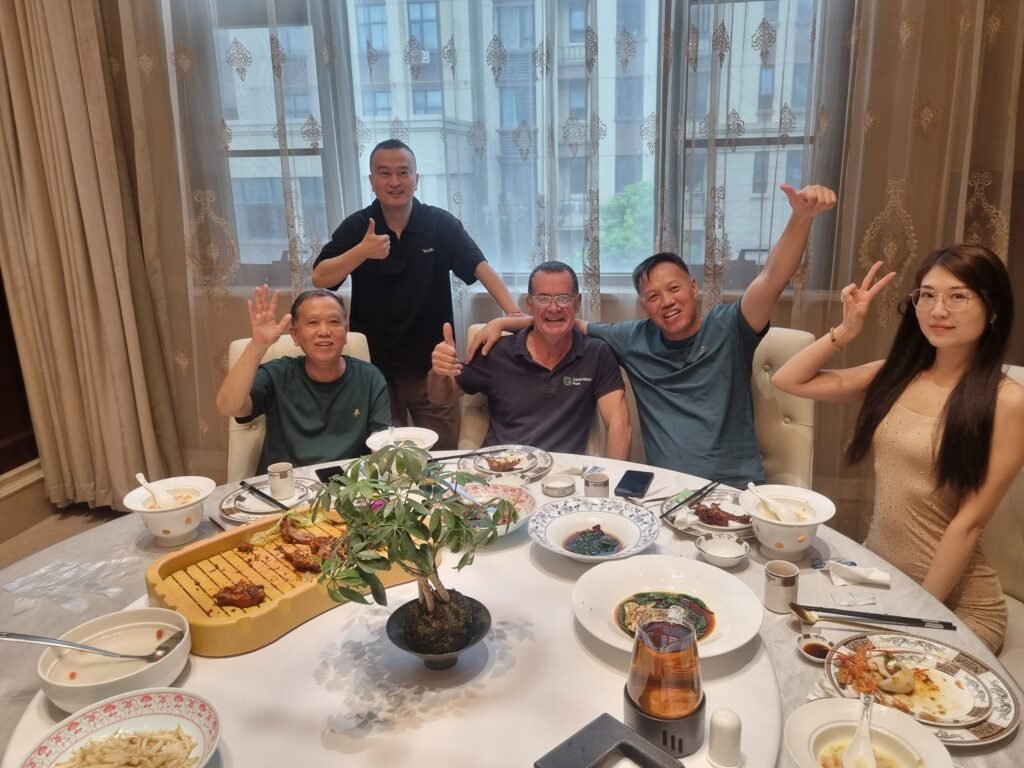
By Colin Steddy Hemp Inside Pty Ltd | iHemp NSW Executive Member In late July 2025, I headed to China to reconnect with key partners and explore the latest in fiber, plastic, and board manufacturing technology for hemp. The trip was fast-paced, full of factory visits, long train rides, and great conversations over tea — but most of all, it reaffirmed just how fast hemp innovation is moving in China. Shanghai: Fiber Processing Reimagined After leaving Vacy early on July 30, I arrived in Shanghai late that night where my long-time contact, Victor, met me at the airport. We eventually found his car after a short adventure in the car park and drove three hours to the hotel, pulling in around 3:40 a.m. Despite little sleep, I was keen to see what awaited the next day. At the factory, I was impressed by the level of refinement in their fiber-processing systems. The new long-fiber line, recently upgraded, now requires only two operators instead of nine. It runs cleanly without the need for an underground pit — a big saving — and automatically bales the finished fiber. The new setup handles stalks under 5 mm thick, blowing the Hurd cleanly into a separate bin. Equally impressive was the short-fiber line, featuring a redesigned drum that treats the fiber gently, maintaining its length and softness. The integrated dust-extraction system can service both lines simultaneously, allowing any short fiber from the long-line process to be redirected — meaning virtually no waste. Although each line currently outputs about 300 kg of fiber per hour (roughly one ton combined), the modular design means five units could outperform a five-tons-per-hour European system at a fraction of the cost. That evening over supper, I reconnected with Eric, an interpreter from a previous trip, and his colleague Tim, a Dutch-born Chinese fiber specialist with a distinctly Australian sense of humor. Over coffee, we discussed how Australian hemp fiber could fit China’s high-volume textile markets. China’s grading system is still largely based on experience — “look and feel” rather than numbers — but their eye for quality is sharp. The conversation reminded me how important hands-on understanding remains in this trade. Jinan: Natural Fiber Plastics The next leg took me north by high-speed rail to Jinan. Steven from GW Plastics met me and introduced me to their automated molding operation — one worker producing a pallet of parts every three minutes. Their latest trials blend up to 80 percent natural fiber with plastic. The result is stronger, lighter, and less brittle — an ideal direction for sustainable materials. I immediately thought of potential applications for hemp, from injection-molded components to structural profiles. One idea we discussed was a “plastic rebar” or concrete straightener — using waste plastic and hemp stalks together. It’s the kind of circular solution that could really take off as green construction grows. Cement Boards and Bio-Composites From there I met Kevin, who manufactures cement board machinery used around the world. His plant featured two systems: a 100-metre heat-based line that requires glue, and a 50-metre cold-press version that doesn’t — fully automated, simple to run, and versatile. Boards ranged from thin 2 mm sheets up to 120 mm sandwich panels. This technology, combined with hemp fiber, could produce strong, lightweight, and toxin-free panels — exactly the kind of building materials the market is demanding. Every machine component met European electrical standards, meaning compatibility with Australian regulations would be straightforward. That evening, I checked into a modest hotel and ventured out for dinner, finding that everywhere I went, WeChat was the key to doing business. It’s more than just messaging; it’s the backbone of communication and payments in China. It’s clear I’ll need to set up a proper account before my next trip. Panjin: Reed and Hemp Board Futures A few days later, after a long standing-room-only train ride, I arrived in Panjin to meet Mr. Zhang, who runs a major reed-board manufacturing facility. Liz, an excellent interpreter, joined us for the tour. The factory processes 30–35,000 tons of reeds annually — material harvested from local wetlands and stored in large bales much like hay or hemp. The plant was spotless, with no visible dust and a sweet smell from the natural lignin binding the boards. Workers weren’t masked or suited up — the process itself is that clean. Over lunch, we discussed the potential for hemp as a feedstock. Mr. Zhang already had trialed hemp board and was enthusiastic about the results. He suggested partnering with Hemp Inside to test Australian hemp in his system, with the possibility of building a dedicated mill in Australia by 2027 if the economics and market align. The reed and hemp boards are almost indistinguishable by sight or touch — but hemp may prove to be the stronger and more sustainable fiber. Zhangpu: Wrapping Up and Looking Forward My final stop was Zhangpu, where I reunited with Mr. Xu — a long-term collaborator and friend. Over several days we shared meals, visited his warehouse, inspected a salt-tolerant kenaf trial, and talked late into the evenings about hemp’s future. Xu’s knowledge and network across China’s hemp and bio composite sectors continue to open new doors for collaboration. Our discussions confirmed that China is pivoting rapidly toward non-toxic, bio-based materials. Whether in fiber decortication, plastic composites, or natural boards, every manufacturer I met was seeking cleaner, simpler processes — and hemp fits perfectly into that vision. Reflections In just under two weeks, I saw firsthand how China’s manufacturing ecosystem continues to adapt and innovate around natural materials. The common thread across all these meetings was efficiency, integration, and sustainability — each factory taking steps to reduce labor, waste, and reliance on synthetic binders. For Hemp Inside and for Australia’s growing hemp industry, the opportunities are clear. By connecting our clean, high-quality raw materials with China’s processing technology and manufacturing scale, we can accelerate the development of hemp products that are competitive, sustainable, and commercially ready. As I landed back in Sydney on August 11, tired but
Written by Connie Minos | August 2025 EO, iHemp NSW | Director, Ashford Hemp Industries The picture (left) may resonate with many of our readers who have experienced drought and hardship on the land. In 2020, Lonnie and I went to the aid of a farmer friend who needed cattle put down due to ongoing drought. It was a traumatic time. On one of our heart wrenching visits, two of the cows unable to stand, showed signs of being close to calving. After euthanising the cows, Lonnie quickly proceeded to remove the unborn calves. One of the two calves born on the side of a dry dam next to her deceased mother, survived. With low expectations after such a difficult welcome to life we took the calf home. It wasn’t smooth sailing but after 8 months we ended up relocating the calf (Marmalade) to my brothers’ cattle farm near Yetman as her size and zest for life were becoming a bit much for me to manage as her surrogate mother. My daughter Olivia and I just visited my brother and we checked on Marmalade and her third calf, both in pristine condition. Olivia is 19 now. She was 15 when Marmalade was born. She was two when Lonnie and I first entered the hemp industry in 2008. Seventeen years ago. Marmalade is a reminder to me that even in the toughest of situations good things do happen, and it is worth persevering. This has certainly been our experience in the Australian hemp industry. Disappointingly Lonnie and I were unable to attend the Hemp Connect Forum in June. It’s always a wonderful opportunity to engage with others passionate about hemp, whether we’ve known them for years or we become newly acquainted. Thankfully we were able to watch the presentations online and I encourage others who were unable to attend the conference to review them. For those who aren’t familiar with our business, our hemp processor is located in northwest NSW, close to the QLD border. The ingenious, beautiful, award-winning design of the University of Tasmanian Forestry and Timberyards redevelopment is inspirational to all, and we feel a strong sense of pride in knowing the hurd produced for that build came from a hemp processing machine we built and supplied to X-Hemp. The beautiful images and positive comments received from builders and homeowners after supplying over fifty homes and buildings throughout NSW and beyond encourage our continued perseverance in supplying the hemp building industry. The regular and diverse range of alternative product options for bast, fines and hurd, who we send samples, give us hope for the future of the wider hemp industry. A small number of business owners within NSW and Australia continue to promote products from overseas while declaring their interest in promoting the Australian hemp industry. Frustration from this fact is counteracted by the increasing engagement and action taken by the private sector and the government in the Australian Hemp Industry. As a member of iHemp NSW and the Australian Hemp Fibre Processing group, and as a small business in NSW, we have every intention of being in this industry for years to come.
By Dr Maggie Davidson MAIOH, Senior Lecturer, Environmental Health & Occupation Hygiene, School of Science, Western Sydney University. Farming is one of the most hazardous jobs. Farmers often live where they work, so there’s little time for rest — especially for their lungs. While accidents are common, long-term health risks from dust, noise, and chemicals often get overlooked. In hemp processing, dust and noise are big issues. But we still know very little about how much dust and noise are actually produced, or which tasks cause the most exposure. This information is important because it helps us find better ways to protect processors, farmers and workers and prevent serious health problems. Organic dust from hemp can cause serious lung issues. Inhaling a lot of dust can lead to: Airway irritation and allergies Byssinosis (“Monday morning fever”) Farmers’ lung (hypersensitivity pneumonitis) Chronic bronchitis What We Did From January to March 2025, we visited hemp processors to observe the work environment and measure dust and noise levels. We took dust samples from the air around workers during different jobs like loading machines, bagging products, cleaning, and maintenance. Dust particles we measured were tiny — less than one-tenth the width of a human hair — meaning they can easily reach deep into the lungs. Key Findings Dust levels peaked at 1.0 to 3.0 mg/m³ during dry sweeping and using air blowers. Loading hammer mills and decorticators produced 0.5 to 1.0 mg/m³ of dust. Safe Work Australia sets the exposure limit at 1.0 mg/m³ over an 8-hour shift. So, sweeping and blowing created dangerous levels. Some dust contained respirable silica, which can cause severe lung disease. Levels reached up to 0.045 mg/m³, close to the legal limit of 0.05 mg/m³. Biggest Risk Areas Loading hammer mills and decorticators Cleaning dust filtration systems Using blowers and dry sweeping What Needs to Change To protect workers: Stop using blowers and dry sweeping immediately — they create the most dust. Use wet cleaning methods and HEPA H-Class vacuums (AS/NZS 60335.2.69 standard). Apply the Hierarchy of Controls: Eliminate/Substitute: Only buy clean, quality hemp with no mould, dust, or contamination. Engineering/Isolation: Install barriers and dust extraction systems to trap dust before it spreads. Administrative Controls: Schedule regular cleaning and machine maintenance. Ban sweeping and air blowers. Personal Protective Equipment (PPE): Supply and train workers to properly use Class 2 or 3 respirators, fitted and tested for the right protection. Where to Find Help Safe Work Australia has excellent free resources: Managing Work Health and Safety Risks Managing Hazardous Chemicals Preventing Hearing Loss at Work What’s Next We are working with hemp processors to develop dust and noise management plans. We’ll revisit them in 2025–2026 to see how improvements are going and share updates at industry events later in 2025. Thank You A huge thanks to the farmers, businesses, and partners who welcomed us. Special thanks to the AIOH Foundation and Western Sydney University for funding this important work.
YOUR INVITED TO A Meeting to discuss the formation of an Industrial Hemp Hub for the NSW Central West When: Friday 22 November (11:00am and finish around 3:00pm) Where: WSU Transition Hub (corner of Mort & Bridge Streets, Lithgow) What: a two-part meeting to discuss: what an Industrial Hemp Hub is and would do in the region (11:00-12:30pm) an overview and feedback on known opportunities and interests in the Lithgow and Central Western Region (1:30-3:00pm).As part of the workshop, participants will visit the Lithgow Women’s Shed, a beautiful hempcrete build in progress. Background Who suggested this meeting? John Muir is working with Ken Dodds as part of a new CRC-P (Cooperative Research Centre) funded by the Federal Government and REVOX (a private company with links to Melbourne University). They are looking at recycling materials to mix with hemp and identify ‘hubs’ within regional rural communities with enough like-minded individuals, who would be willing to share resources and experience to create working supply chains that grow and supply a range of industrial hemp products. Why Lithgow? Lithgow is now home to one of the larger public buildings constructed with hempcrete. It’s s a region where local government is highly focused on regional development (including agriculture) as the area transitions away from coal. This makes it potentially eligible for transition funding once the State Government releases its program of Transition Authorities for regions like ours. Lithgow Transition Hub (Western Sydney University) A series of workshops will be hosted in Lithgow in February as part of an academic research program aimed at generated a ‘social-license’ for growing and manufacturing products from industrial hemp. That program will be led by Prof Neil Perry (WSU) with Prof Louise Crabtree (WSU), Dr Stephen Heally (WSU) and Dr Michelle Zeibots (UTS). This November meeting is being approached as an opportunity to scope the content, structure and discussion points for the more detailed workshops in February. If you would like to attend, please contact: Dr Michelle Zeibots MPIA CILT Senior Lecturer (Transport) School of Civil & Environmental Engineering Faculty of Engineering & Information Technology University of Technology Sydney M. 0408 437 687 PO Box 123 Broadway NSW 2007 Australia
My Amazing Visit to China 4 -16 October 2024 By Colin Steddy – Hemp Inside Access to seed I flew to Xiamen and was driven to Zhangpu, to catchup with Mr Xu and his father Rong Long from ZHANGPU ZHONGLONG KENAF SEEDS CO, LTD. I first imported seed from Xu in 2017 after my visit in 2016 and have kept close contact since. We have formed a strong relationship. Working together with ideas on how to do more than just seed. China can now get permits to grow in most parts of China. The THC must be below 0.35 unless you have a breeding licence. Mr Xu has a breeding program with a government centre in China, paid for by Xu, looking at hybrid hemp seed production. For me, it was an interesting site visit because: we are talking new varieties of hemp the breeding program is looking at 4 tonnes per ha, so hemp can compete with soy. Currently there is a world shortage of hemp seed for food and planting seed. I am hearing reports of low yields and low germination across the world. ZHANGPU ZHONGLONG KENAF SEEDS CO, LTD has potential to produce eight hundred tonnes of planting seed for export around the world. Hunter Valley Hemp Seed & Grain, a new enterprise with Bob and Susan Doyle and myself. We will be growing the Chinese varieties in early 2025 for planting in the 2025 September season. We will also export. Please contact me for information. Details below. Research needed New research needs to be done on the flowering and pollen drop with dioicous varieties. With the findings that seed from around the world is having issues with low seed germination and bad vigour. We thought this was to do with heat and temperature; there is more to learn about the flowering times especially in diecious varieties. Mr Xu and I have been working on a seed testing protocol. When male pollen falls, are the females ready and what are the weather conditions? Is it cold and wet are the day length short? This looks like the results at Hamilton in Victoria for the long season varieties. Because of cold short days there was little seed produced exactly as I have been suggesting. Long season seed crops should be grown in the north then moved south for fibre and biomass production. Could this also be a result of germination rates falling quickly and low plant vigour? We are looking for the collection of flowering and weather conditions in relation to germination rate drop and low seed vigour. I would like our researchers to look at this. Exploring seed testing protocols We are looking at building new seed testing protocols on how to monitor what might happen with seed longevity. The hemp industry in Australia needs to keep all data from planting and fertiliser inputs and timing. What triggers THC spikes? Why do seeds loose germination? Fibre quality, planting density (plants per m2) and fertilise can have an enormous impact. Let alone how the machinery and retting occur. Know the spec from the end user? In the north of Australia long season varieties continually get higher grain yields. South European, and some Australian varieties do better than in the hot north. How you move the varieties in latitude will give you a different outcome, seed size, yield, or biomass. This also happens in China just south to north. See AgriFutures hemp trial results from all sites in Australia. The one thing that has not been calculated in the result is grain yield/price and biomass price. As a grower we need to know the total income from a crop. You can work this out yourself. Find the yields of biomass and seed and give them a value on current market. I work on $2.65 for grain and $3.50 for biomass as the stalk is less value than just a biomass crop. Currently in China there is a large demand for hemp fibre and China is sourcing fibre from every corner of the world. Is your fibre going into textiles, insulation, weed matting or paper? Each end product requires different specs and price. How much hurd can be in the fibre? Or is it a whole stalk product? My visit to a textile mill I visited a textile mill in Shanghai (CPL) that want to purchase textile fibre from Australia; the mill makes clothing, with hemp blended with other fibres. Lisa was my interpreter and looked after me. Their demand is growing, and they could be looking for up to 10,000 tonnes! Once again, I was treated like a king and taken to dinner and sightseeing to Xitang, an old Chinese town. Usually it is very crowed, but it was raining and was thankfully incredibly quiet. The market was a maze of thin walkways with shops selling food and a vast array of items big and small. It was very beautiful. This mill has a contact living in South Australia. His name is Yao Yang, and he kindly organised my visit. I wanted to see the fibre quality they need so I can help Australian growers and processors meet the specifications. Today there is a massive shortage of textile hemp fibre – how long it will last, we do not know. I introduced them to Mr Xu, my friend in Zhangpu. Unlike Australia, the industry in China is large and they were not familiar with each other. Along with Lisa, my interpreter, Mr Chunlei Hou and Professor Fan, a polymer academic took me to lunch. They were very warm and friendly. Before we drove to the mill, we discussed growing the right fibre, retting and what spec they need. They have some samples from Australia that need to have less hurd – below 10% is ok. The only mill I know that is close to their spec is Gary Rogers in WA and Bob and Susan Doyles’ that needs a few modifications to clean the fibre and the dust extraction.