

In memoriam – Beatrice Kuyumgian-Rankin
Beatrice was one of those rare people who leaves an indelible mark on everyone fortunate enough to cross her path.
Licensed farmers and producers growing industrial hemp for fibre, hurd, seed, or flower across Australia.
Beatrice was one of those rare people who leaves an indelible mark on everyone fortunate enough to cross her path.
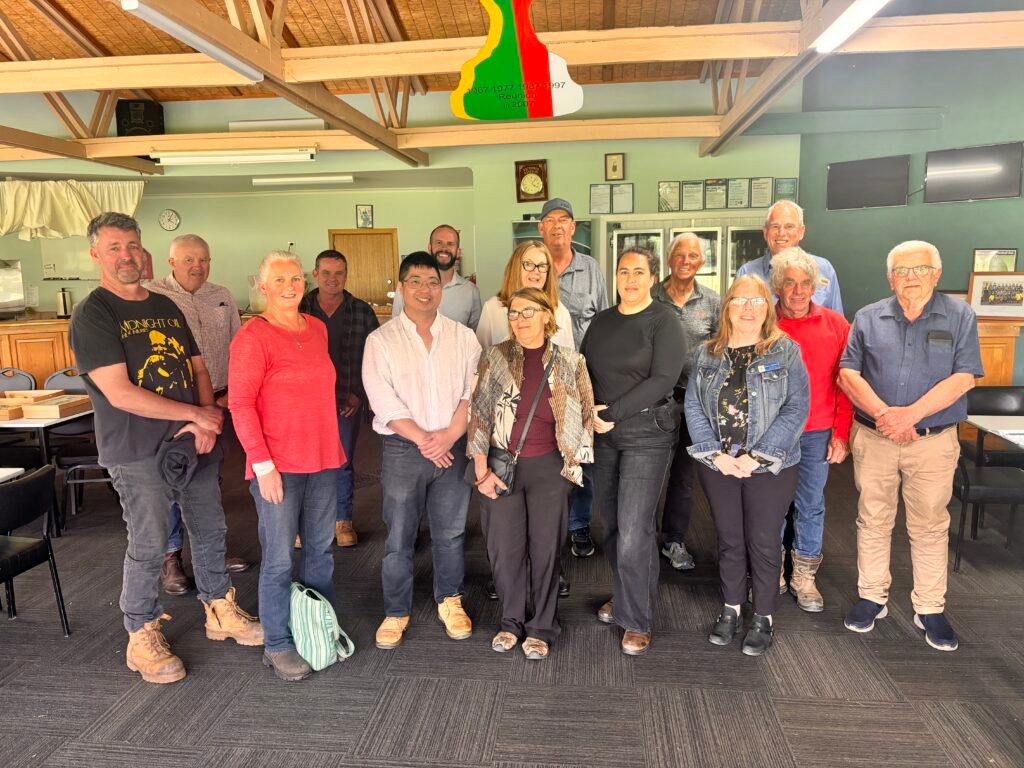
Gippsland region’s emerging industrial hemp industry…The conclusion was optimistic: Orbost presents a genuinely compelling case for becoming Australia’s first dedicated industrial hemp processing hub.
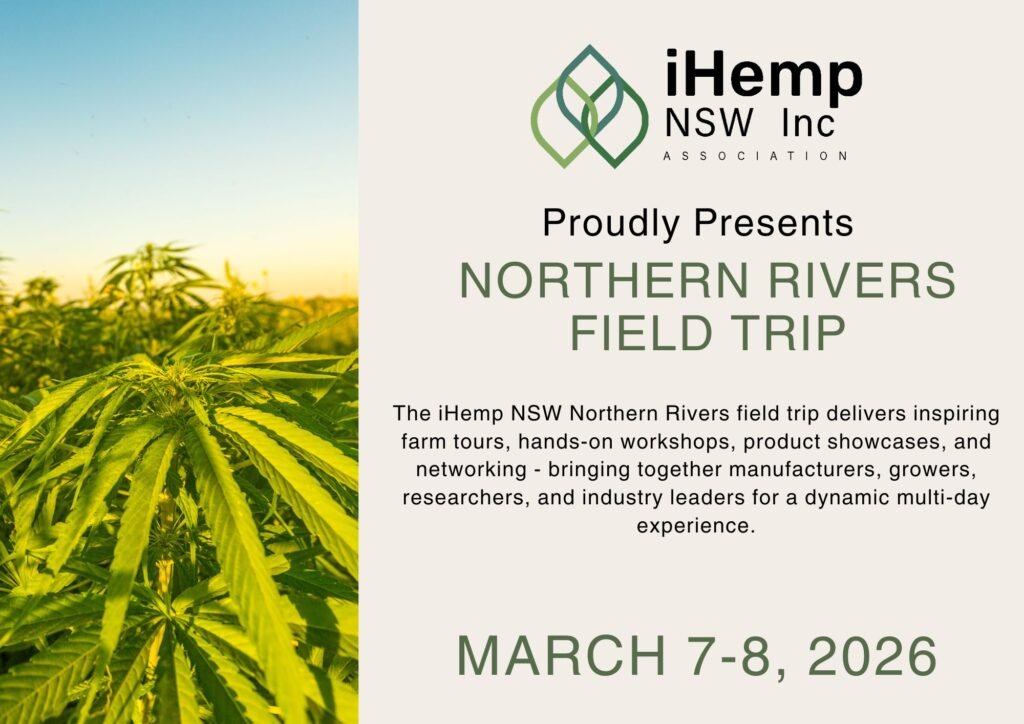
The iHemp NSW committee is excited to announce an inspiring 2.5-day field trip in the beautiful Northern Rivers region is in the making.
These past few months have seen Ashford Hemp Industries (AHI), Leon Minos working hard with the team to get a second Ashford Hemp Processor established in New Zealand. Meanwhile Connie is wanting to talk with farmers who are growing or are considering growing hemp in North-West NSW to procure ongoing supply of quality bales. New Zealand’s Venture Taranaki have ramped up their hemp industry development with the purchase of an Ashford Hemp Processor. The installation differs to other processors AHI has supplied and we’re keen to see it in full operation over the coming days. If you would like further information about purchasing a Hemp Processor, please contact us on the details below. While Leon has been enjoying the beautiful scenery in the Taranaki area, Connie and the processing team continue to be busy processing hemp to supply hempcrete builds in NSW and QLD. “We are keen to establish an ongoing supply relationship with farms in the North-West NSW or southern QLD to ensure we continue meeting the growing demand of hemp fibre. Growing hemp generates soil improvement and income, but there are several key points that are essential in ensuring these benefits are accessed by both farmers and processors,” says Connie. Please contact Connie on the details below if you would like more information. Connie Minos EO iHemp NSW Director, Ashford Hemp Industries Ph 0477812163 E:connie@ashfordhempindustries.com

By Winton Evers | Managing Director | Eco Profit Management Pty Ltd Introduction Eco Profit has been developing the Eco Profit Hemp Platform, a live lifecycle carbon removals/emissions tracking tool throughout the hemp value chain. Please go to the link in the Hemp Building Directory for some background on the project. It has three stages: Stage one: the creation of a marketplace for hemp to join buyers, sellers and all stakeholders in the industry whilst introducing product specifications and forward contracting throughout the value chain (providing market certainty). Stage two is the creation of the provenance tool that will include GS1 barcoding and will track all hemp biomass from paddock to end product. This will mean the collection of the appropriate data right across the value chain. Stage three is the creation of carbon offsets. In Australia, that will mean getting approval from The ACCU Scheme to create official carbon offsets. However, to be able to get to this stage will require crops generally being recognised as being able to be used for storing carbon permanently (such as in buildings) and the hemp crop being recognised in Australia’s National Greenhouse Gas Inventory (NGGI). On the first point, the UN Intergovernmental Panel on Climate Change (IPCC) which dictates the rules for national greenhouse gas emissions calculation is in the process of approving a new sub-category called Harvested Non-wood Biomass Products that will be a game changer. To the second point, the hemp industry will need to demonstrate that it will shortly be a material crop i.e. permanent carbon removals of greater than 0.5% of Australia’s national emissions and also, to be able to provide extensive data that will allow the Clean Energy Regulator to be able to facilitate its inclusion in the NGGI. With the goal of achieving that recognition I have prepared a suggested simplified roadmap to get there as follows: Phase 1 – Measurement & calibration (12–24 months) Conduct multi-state field trials on an ongoing basis to quantify hemp’s key crop attributes: dry matter by component, carbon content, residue returns, and SOC baselines underpinned by quality assurance/quality control (QA/QC) protocols and RothC validation. Please see Appendix A below with field trial details. Phase 2 – National data pipeline Formalise area, yield, and management reporting through ABARES/ABS or interim industry reporting aligned with their standards. Each state regulator would need to share data on licensed hemp plantings and harvests, and the Hemp Platform can capture this directly from the paddock to ensure transparency and traceability. Practically: create standard forms/application programming interfaces (APIs) for growers, processors, product manufacturers and product end use, QA/QC rules, aggregate by LGA/state, publish annual stats, get state regulators to share licensed planting/harvest data and work with ABARES/ABS towards inclusion in official ag statistics. Phase 3 – Integration with FullCAM Once crop data is validated, collaborate with DCCEEW to: Add hemp to the CAMAg crop list, Define management splits (residue retention, tillage, irrigation), and Integrate hemp into annual cropland modelling. This would enable Australia’s greenhouse gas inventory to reflect both emissions and removals associated with hemp cultivation and management. Phase 4 – Product durability & standards (future-proofing) Commission/collect studies on the durability and half-life of hempcrete and hemp composites, establishing credible parameters for the forthcoming HNBP framework. Work includes (such as the work Klara has been doing): Developing a Standards Australia Technical Specification for hemp-lime walling. Supporting National Construction Code (NCC) compliance through accredited testing and certification. Using the Hemp Platform to trace carbon removals across the value chain from crop to finished product. Phase 5 – ACCUs (future opportunity) Once the HNBP category is formalised, pursue an ACCU method for carbon storage in durable hemp products. In the meantime, build the evidence base: measure service-life, end-of-life outcomes, SOC change, and management practices. This ensures the industry is method-ready when the opportunity opens. This includes ensuring the data is captured from soil sequestration ACCU projects which involve associated hemp planting. APPENDIX A 1. Set up site-specific model inputs Climate: monthly rain & temperature and potential evapotranspiration (PET). Soils: clay %, bulk density, initial soil organic carbon (SOC) by depth, inert organic matter (IOM) estimate. Management: tillage, irrigation, cover crops. Carbon inputs: measured residue & root carbon, stubble height/returns. 2. Partition plant material into pools Map lab data e.g. lignin/ acid detergent fibre (ADF)/ acid detergent lignin (ADL), carbon-to-nitrogen ratio( C:N) to decomposable plant material/ resistant plant material (DPM/RPM) fractions required by RothC (fast vs resistant decomposable pools). 3. Calibrate starting state Use the baseline SOC e.g. 0–30 cm, equivalent soil mass) to initialise model pools including IOM for each site/plot. 4. Run forward with measured inputs Drive RothC with observed monthly inputs and management for the trial period (12–24+ months). This will mean accessing the RothC program and understanding specific data inputs into the program. 5.Compare model vs measurements Check predicted vs measured SOC stocks/stock-change (by depth, usually 0–10 & 10–30 cm). Stats: root mean square error/ mean absolute error (RMSE/MAE), bias (mean error), Coefficient of Determination(R²)/Nash–Sutcliffe; confidence intervals via Monte Carlo on uncertain inputs. 6. Sensitivity & uncertainty Vary key parameters (DPM/RPM, residue C, clay %, IOM) to show robustness and quantify uncertainty ranges. 7. Cross-site validation Demonstrate performance across multiple states/soils/rotations (not just one site) to show generalisability. 8. QA/QC evidence Field/lab standard operating procedures (SOPs), duplicates/blanks, bulk density & SOC lab checks, outlier rules, equivalent soil mass (ESM) corrections, versioned model configs.
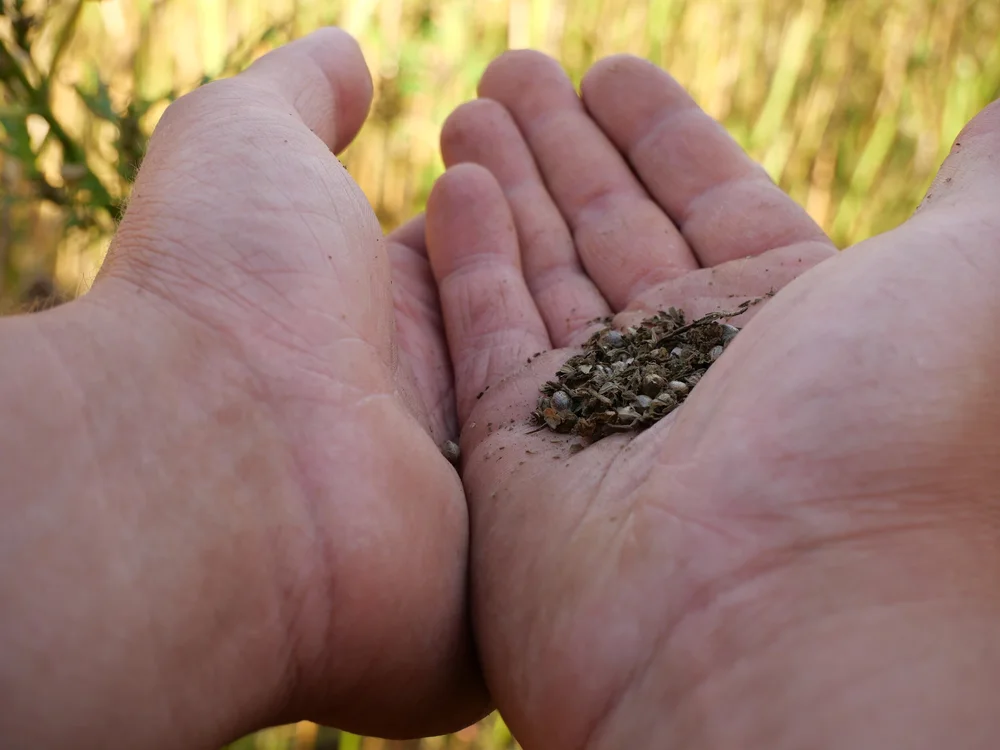
Industry Response to the Senate Inquiry: Opportunities for the Development of an Industrial Hemp Industry in Australia The response to Senator Richard Colbeck’s call for submissions to the Senate Standing Committees on Rural and Regional Affairs and Transport’s inquiry into the Opportunities for the Development of an Industrial Hemp Industry in Australia was both strong and diverse, with 64 submissions received from across the nation. Submissions came from farmers, processors, researchers, builders, health and wellness product manufacturers, advocacy groups, and government agencies, reflecting the depth and breadth of interest in unlocking hemp’s full potential for Australia. A number of consistent themes emerged across the submissions. Agronomic advantages Many highlighted the agronomic advantages of hemp as a sustainable, low-input crop that fits well into regenerative farming systems, supporting soil health, carbon sequestration, and water efficiency. There was a strong emphasis on regional economic development, with hemp positioned as a diversification opportunity for farmers and a driver of new jobs in processing and manufacturing. Regulatory reform Stakeholders also focused on the urgent need for regulatory reform, calling for the removal of industrial hemp from drug-related legislation and for national harmonisation of licensing, THC thresholds, and compliance systems. The inquiry revealed that fragmented regulations are among the largest barriers to growth, limiting investment and cross-border trade. Value-added manufacturing Submissions underscored the growing potential for value-added manufacturing, particularly in hemp-based building materials, textiles, bioplastics, food, and wellness products. The construction and materials sector featured prominently, with strong calls to fast-track building code recognition for hempcrete and fibre board, and to align with international standards to enable rapid scaling. Research and development investment A further theme was the need for increased research and development investment, particularly in seed genetics, agronomy, processing technology, and product innovation. Stakeholders called for coordinated national leadership and industry collaboration to link research institutions, growers, and manufacturers. In summary Overall, the submissions presented a unified message: industrial hemp represents a significant economic, environmental, and social opportunity for Australia, but its success depends on policy alignment, investment in infrastructure, and continued cross-sector collaboration. The level of engagement in this inquiry highlights a maturing, motivated, and solutions-focused industry ready to contribute to Australia’s low-carbon, circular, and regionally based future.
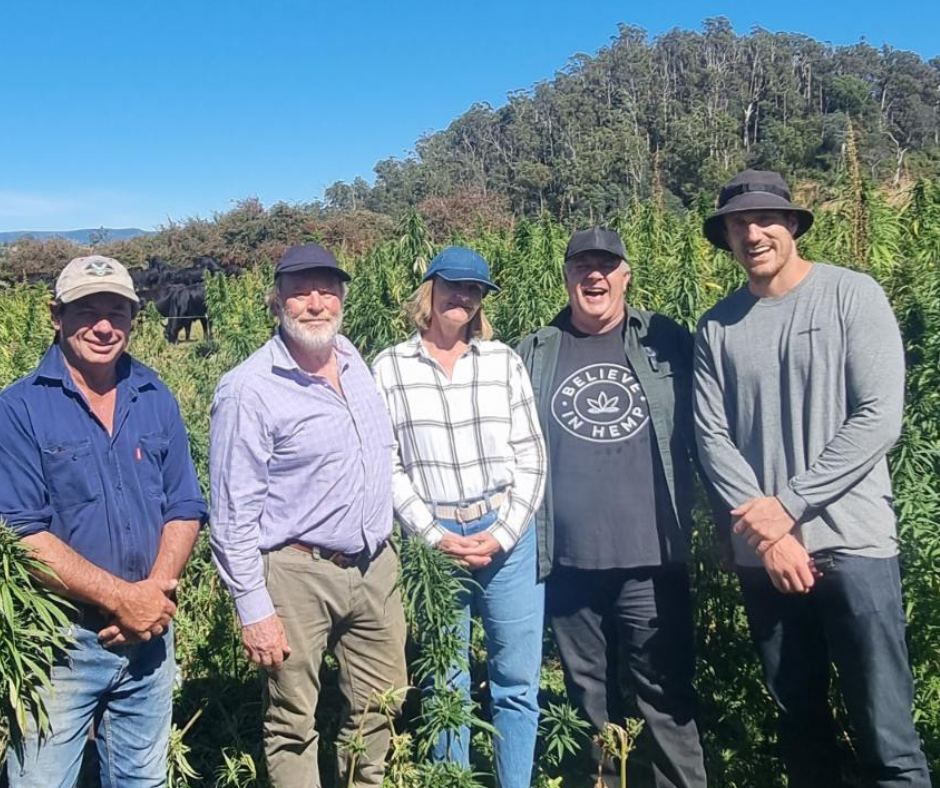
By Tim Schmidt | August 2025 Tasmania is now re-emerging as the powerhouse of hemp seed for food production in Australia. The massive stockpile from 5 years ago has disappeared and there is now a national shortage. The 2024 harvest was from a mere 34ha of hemp seed food crops, being the lowest area since 2017, the 2025 harvest jumped to 300ha and still that was not enough. The new season coming up, is forecast to be greater than 300ha. An urgent issue for the hemp seed food industry is the expiring of the spray permit for bromoxynil, an essential broadleaf herbicide which is required to help maintain profitable yields. Without this tool for production, the industry will quickly fold. This permit will expire early next year, so next year’s planting is at risk, we can only hope that the AHC will be successful in requesting an extension for the permit until work undertaken by Agrifutures produces the data required for the longer term permitted use of bromoxynil. The Tassie Hemp Co is looking to work with local wine producers and the Tasmanian Institute of Agriculture in running hemp mulch trials to show the beneficial impact on production and quality of wines using hemp mulch. There had been work conducted here 20 years ago on hemp mulch for pink lady apples which showed a distinct improvement in fruit quality, we hope to show the same for Tasmanian wines. We are very fortunate to have Hemp Harvest processing our hemp seed here near Deloraine, they have been perfecting their processes and are producing above average yield results, which is an important improvement on our industry viability in Tasmania. Checking out the crop. L- R: Tim Schmidt, Phil & Kiley Warner, Arthur Wajs and Tim Crow. Stephanie Cameron, Tim Schmidt and Senator Richard Colebeck in Tim’s last season crop.
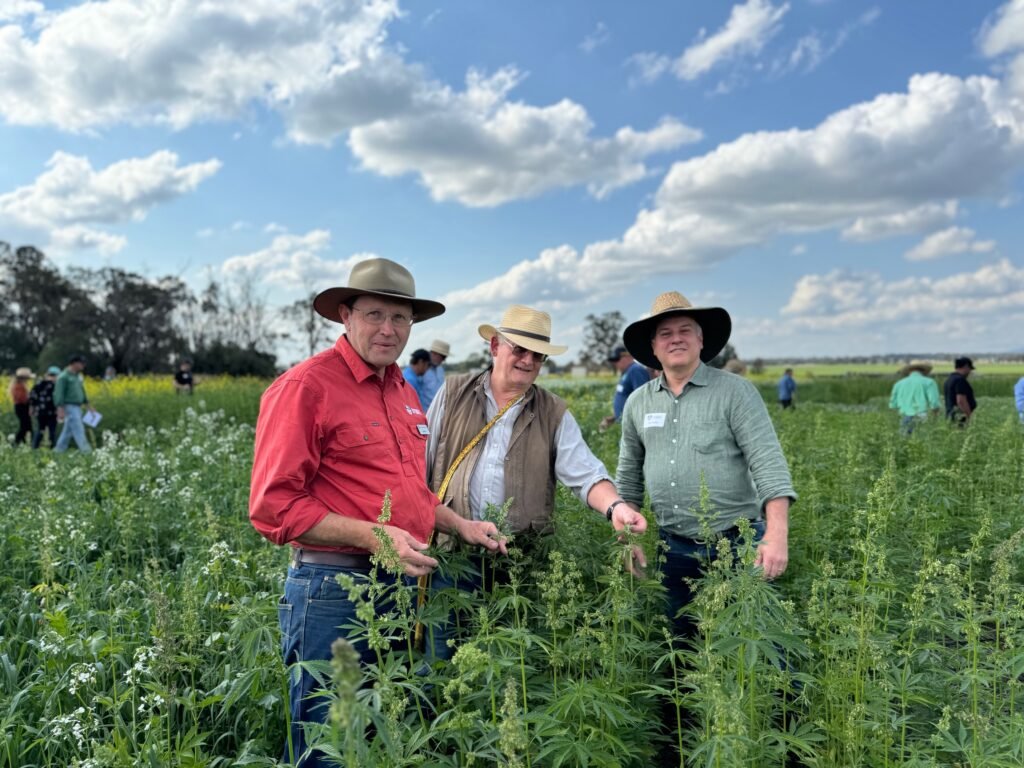
By John Muir, Agronomist | August 2025 The iHemp NSW Field Trip on September 11, 2024, visited the University of Sydney’s Narrabri Research Station and a cotton farm in Moree as part of the annual winter crop field day. Among the many crops on display, hemp emerged as a standout feature for the 300 guests in both field observations and presentations. Included in one of Narrabri’s many alternate winter species dryland cover crop projects, hemp had been sown in addition to the AgriFutures summer sown irrigated crop variety trials. Traditionally a summer crop, hemp often struggles to establish in high air/soil summer temperatures. Recognising this, Professor Guy Roth, Director of Northern Agriculture from the Sydney Institute of Agriculture, extended sowing dates into winter – and the results were surprising.As part of the broader winter green manure /cover cropping program preceding dryland summer cotton, the trial featured a mix of cereals, brassicas, legumes, and hemp. All crops were sown no-till, into 5 tonnes per hectare of wheat stubble on June 22. Around three months later, on September 11 – following a frosty winter – the field day showcased an unexpected standout leader: hemp. By 60 days after sowing, the HFA Ruby variety had reached mid-flowering, stood approximately 0.75 meters tall, and had achieved an estimated biomass of 3 tonnes per hectare. Hemp’s frost tolerance in its vegetative stage proved advantageous. As long as flowering occurs after the winter frost, hemp can fill and finish, just like a winter crops, into spring and completing grain fill before the hot, dry summer sets in. The trial yielded over 500 kg/ha of grain, despite a significant portion of seed shattering prior to harvest. Like canola, hemp is indeterminate and tends to have uneven maturity, making timely harvest critical. Even with some losses, at a market price of $3,000 per tonne, the return equated to approximately $1,500/ha. This result is just the beginning. With further improvements in genetics, agronomy, and environmental understanding, the potential for winter-sown hemp in southern Australia is immense. And new trials are already in this year including dryland winter commercial crops in NSW to South Australia. Further Information: For additional insights, refer to the April 2024 extract of a presentation at Australian Industrial Hemp Conference, written by John Muir, Polish breeder of Henola and Don Telfer DPIRD WA, and AgriFutures Knowledge Hub.

Written by Connie Minos | August 2025 EO, iHemp NSW | Director, Ashford Hemp Industries The picture (left) may resonate with many of our readers who have experienced drought and hardship on the land. In 2020, Lonnie and I went to the aid of a farmer friend who needed cattle put down due to ongoing drought. It was a traumatic time. On one of our heart wrenching visits, two of the cows unable to stand, showed signs of being close to calving. After euthanising the cows, Lonnie quickly proceeded to remove the unborn calves. One of the two calves born on the side of a dry dam next to her deceased mother, survived. With low expectations after such a difficult welcome to life we took the calf home. It wasn’t smooth sailing but after 8 months we ended up relocating the calf (Marmalade) to my brothers’ cattle farm near Yetman as her size and zest for life were becoming a bit much for me to manage as her surrogate mother. My daughter Olivia and I just visited my brother and we checked on Marmalade and her third calf, both in pristine condition. Olivia is 19 now. She was 15 when Marmalade was born. She was two when Lonnie and I first entered the hemp industry in 2008. Seventeen years ago. Marmalade is a reminder to me that even in the toughest of situations good things do happen, and it is worth persevering. This has certainly been our experience in the Australian hemp industry. Disappointingly Lonnie and I were unable to attend the Hemp Connect Forum in June. It’s always a wonderful opportunity to engage with others passionate about hemp, whether we’ve known them for years or we become newly acquainted. Thankfully we were able to watch the presentations online and I encourage others who were unable to attend the conference to review them. For those who aren’t familiar with our business, our hemp processor is located in northwest NSW, close to the QLD border. The ingenious, beautiful, award-winning design of the University of Tasmanian Forestry and Timberyards redevelopment is inspirational to all, and we feel a strong sense of pride in knowing the hurd produced for that build came from a hemp processing machine we built and supplied to X-Hemp. The beautiful images and positive comments received from builders and homeowners after supplying over fifty homes and buildings throughout NSW and beyond encourage our continued perseverance in supplying the hemp building industry. The regular and diverse range of alternative product options for bast, fines and hurd, who we send samples, give us hope for the future of the wider hemp industry. A small number of business owners within NSW and Australia continue to promote products from overseas while declaring their interest in promoting the Australian hemp industry. Frustration from this fact is counteracted by the increasing engagement and action taken by the private sector and the government in the Australian Hemp Industry. As a member of iHemp NSW and the Australian Hemp Fibre Processing group, and as a small business in NSW, we have every intention of being in this industry for years to come.
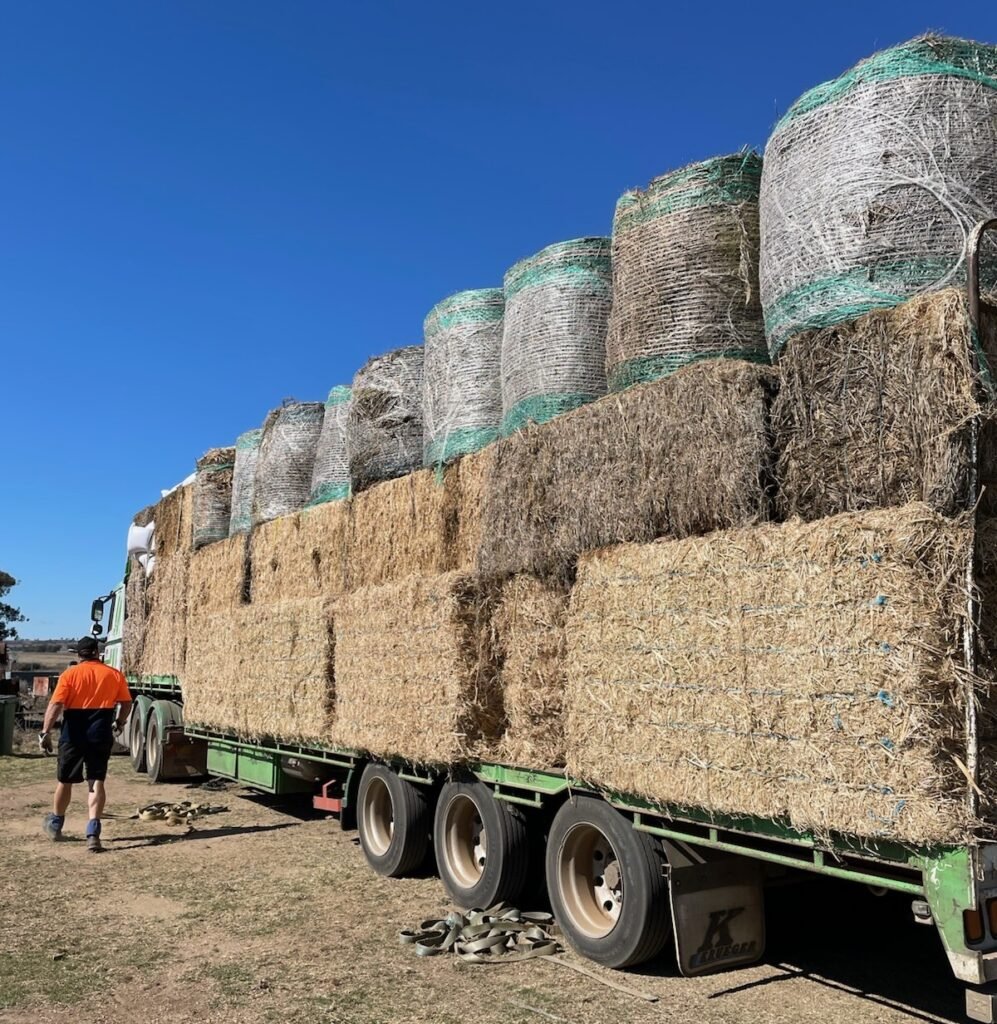
By Connie Minos, iHemp NSW Executive Officer Director, Ashford Hemp Industries. What a wet month we’ve had impacting on so many of us. It’s been a relief to hear that many farmers have been able to get their hemp crops harvested and off the field. I’m sure there are many others who weren’t so lucky. Over the last few months, I have spoken to a number of farmers either experienced in growing hemp or just considering hemp as an alternative crop option for soil regeneration and income diversification. For several years Ashford Hemp Industries have had challenges in meeting hurd orders due to a limited, quality supply of retted hemp. Thankfully this turned around for us over the past year and our production line has been working steadily. While the increase in the number of people growing, or wanting to grow hemp, is an encouraging sign in this industry, it does not come without a warning. While those of us in the know clearly understand the benefits of building with hemp, the harsh reality is there is a slump in the building industry and hemp building has not avoided costly delays and a reduction in new builds. To avoid damaging our hemp farming industry we must ensure that there is a clear understanding of where the market is at before choosing to take on hemp growing, which is neither cheap nor easy. Ideally, we can build up our farming network in coordination with processing facilities across the state, while simultaneously developing the building industry to ensure the quality of hemp is maintained, and that the supply chain keeps moving to the benefit of all players. As always, effective communication is the key, and accessing the supports available through iHemp NSW and other sources is a great place to start.